Back to: Home > Links > Successful Estimating Methods Excerpt
Excerpted from RSMeans' book "Successful Estimating Methods: From Concept to Bid"
Chapter One
Types of Estimates, Tools, Data Sources, Methods
A sound understanding of the common types of estimates, tools
for estimating, data sources, and methods of estimating forms
the basis for more sophisticated estimating concepts. To the
novice, this chapter presents the fundamentals of estimating as
it is practiced in construction today. For the construction
professional, the chapter serves as a review of effective
methods. The remainder of Part I is an expansion of the
introductory information presented here.
Types of Estimates
Estimators typically perform at least five different types of
estimates, depending on their employer and position. These
include preliminary or ballpark estimates, square foot
estimates, assembly or conceptual estimates, contractor's bid
estimates, and engineer's or owner's estimates. Although these
types are generally known by these terms, there are not always
clearly defined boundaries between each type. Figure 1.1 shows
the general progression from the least to the most accurate
estimating types.
Cost analyses for alternative construction methods and
materials, and change order and claim estimates are two special
types of estimates not shown in Figure 1.1. Life cycle cost
analyses, value engineering, and uncertainty analyses are
additional types that do not fit the generalized picture. Each
of these will be treated in later chapters.
Preliminary Estimates
Early in the planning stages of a project, both owners and
designers need, and often demand, an indication of the cost of
the project at completion. Since the project has not yet been
designed, estimates prepared at this time have a low expectation
of accuracy. Names sometimes used to describe such estimates
include preliminary, ballpark, blue sky, seat-of-the-pants, and
order of magnitude. One of the important purposes of these
preliminary estimates is to provide information to an owner or
client so that a decision can be made to proceed with the
project. Preliminary estimates are often made in less than two
hours. The expected accuracy is no better than within 20-30%.
Project comparison is a method of preparing preliminary
estimates when cost data for comparable completed projects is
available. If the comparison project differs substantially in
size, adjustments need to be made for the economy of scale.
Chapter 2 addresses preliminary estimates in detail.
Square Foot Estimates
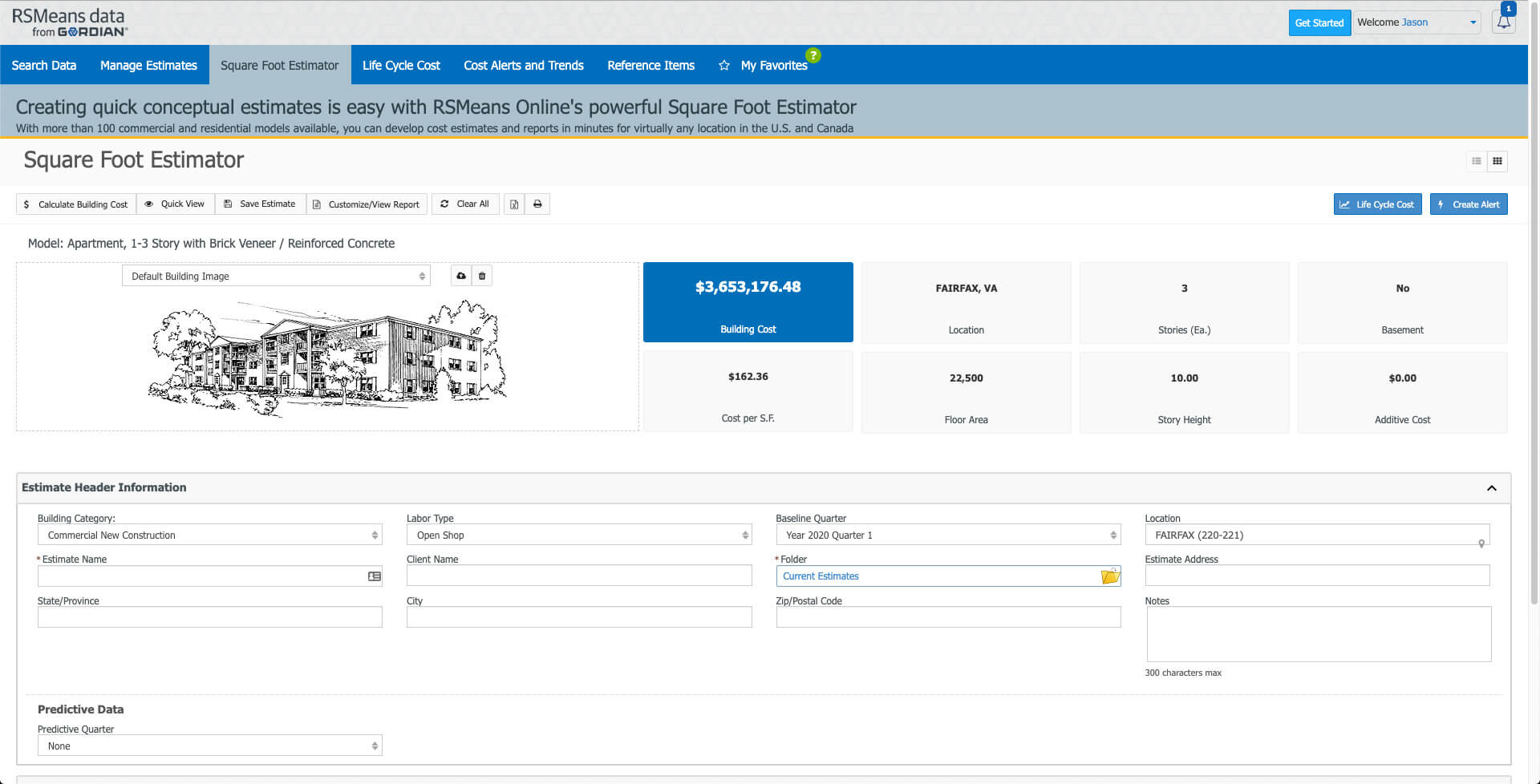
Square foot estimating is another method of developing a
preliminary estimate based on historical data. This technique is
effective in preparing advanced preliminary estimates when
features of the proposed project are known, but not yet
designed. To use this method, it is only necessary to know the
type of building or facility and the proposed number of square
feet. Other unit measures such as the number of beds for a
hospital, or number of spaces for a parking garage are sometimes
used instead of square feet, but the basic method for
determining these estimates is the same. Annual cost data books
are published that provide square foot and other unit costs for
a variety of buildings. Square foot estimates are further
discussed in Chapter 3.
Assembly, Conceptual, or Intermediate Estimates
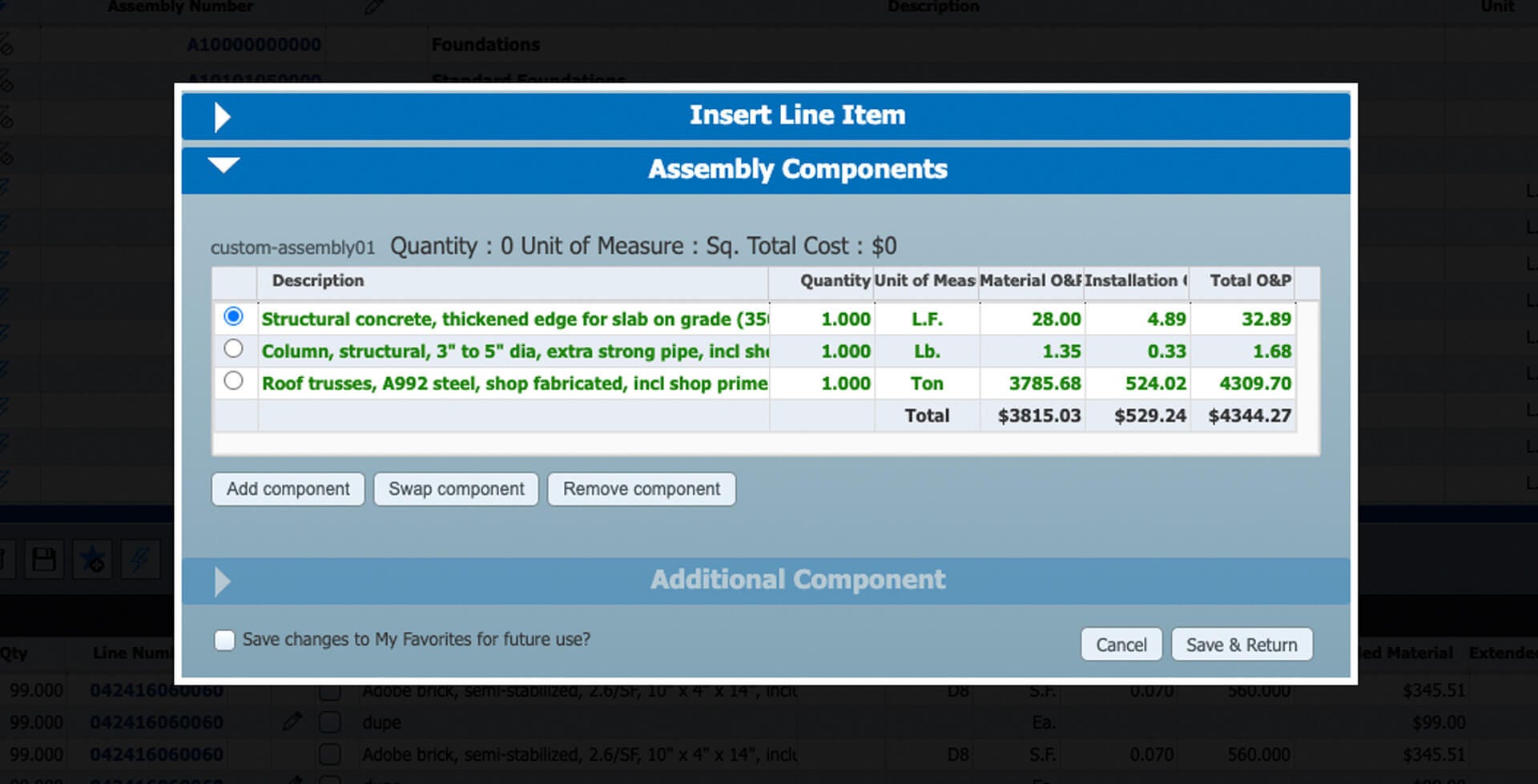
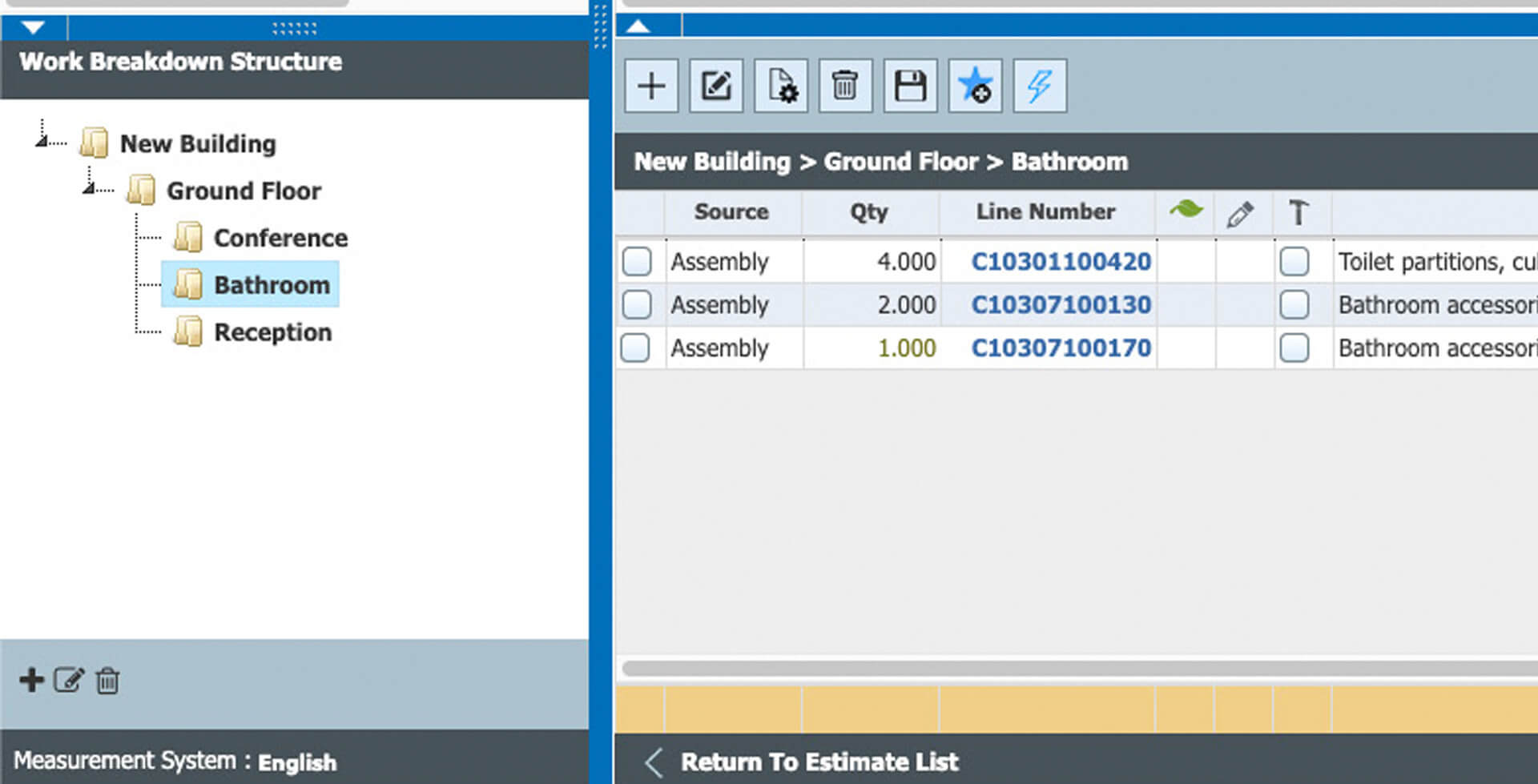
|Assemblies| are groups of the work of several trades combined
into a single cost element. For example, construction of a
bathroom may require work by plumbers, electricians, tile
setters, and carpenters. The assembly cost includes the cost of
participation from each trade, including materials. Publishers
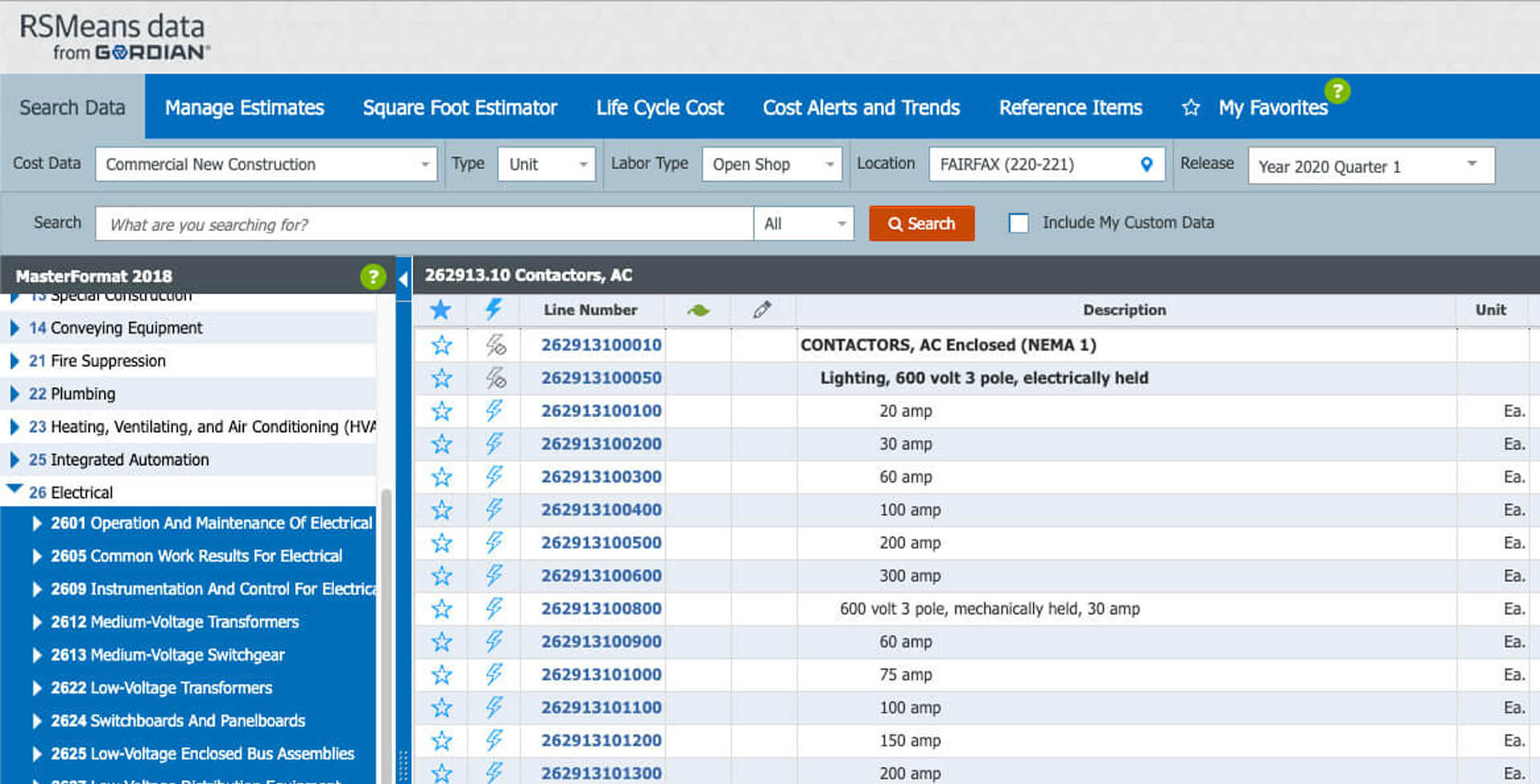
of cost data produce books and computerized data tabulating
assemblies costs that can be used in intermediate or conceptual
cost estimates. |Systems| is another term sometimes used for the
grouping of cost data into a single estimating unit. See Chapter
4 for a more detailed discussion of the assemblies method.
Assemblies costing is also used in detailed unit price estimates
where they may be referred to as Work packages|work packages.|
Here, each contributing trade cost is fine-tuned to the local
area and type of project. This is a powerful tool that both
saves time and improves accuracy for companies doing repetitive
work on the same types of projects. A detailed discussion of the
preparation and use of this type of assembly for unit price
estimating is given in Chapter 7.
Final Estimate Types
Final detailed estimates can be prepared when the design and
contract documents have been completed, or are essentially
complete. Generally two types of final estimates are prepared;
one by the contractor intending to bid the project, and the
other for the owner's use in preparing budgets and evaluating
bids for the project. The estimate prepared for the owner is
called the |Engineer's Estimate| when the owner is a public
agency, and is almost always required for bid comparisons. The
owner's estimate is optional for privately funded projects. The
major difference between a contractor's bid estimate and an
engineer's estimate lies in the information the two estimators
have at their disposal. As reviewed in the Introduction (Figure
I.1) the Estimatorcontactor\scontractor's estimator normally has
much more detailed information at his disposal. The engineer's
estimator is forced to rely on more general information, since
he does not know which contractor will receive the award and
construct the project.
In either case, the final estimate must be as accurate as
possible, since it represents the money that will be received or
spent when the project is actually constructed. Three methods
are often used for these final estimates: unit price estimates,
schedule estimates, and previous bid tabulations. These will be
discussed later in this chapter.
Contractor's Bid Estimates
Contractors competing for work submit firm bids, stating the
amount of money they will require to perform the work if awarded
the contract. When a contractor receives the award for the work,
the bid they submit becomes part of the contract documents and
is legally binding. For this reason, contractor's bid estimates
receive more attention than most other bid types.
Contractor's estimators use a variety of methods to produce
their bids: some use spreadsheets, others use specialized
estimating software. Estimators preparing bids for government or
municipal authority heavy construction projects may combine the
proposed project schedule and the estimate, since meeting the
scheduled completion date is often required by the contract.
Regardless of the method the estimator chooses, they all have
one thing in common: Utmost attention must be paid to every
detail, and multiple checks are necessary to ensure that no item
of work is omitted or duplicated. (Chapter 6 covers this type
estimate in more detail.)
Engineer's or Owner's Estimate
Engineer's or owner's estimates are used both as a basis to
evaluate contractor's bids and to provide the owner with the
budget needed to pay for the construction project. Most
construction administrators believe that the engineer's estimate
should not match the low bid, but should fall somewhere between
the second and third bidders. An analysis of historical data
bears this out. Approximately 235 bid openings were analyzed
where both the engineer's estimate and the low bid were known
(based on bid tabulation data published in Engineering News
Record over a period of about eight years). Figure 1.2 is a
histogram showing the distribution of the percent deviation of
the low bid from the engineer's estimate. A statistical analysis
of the data suggests that the average low bid is 7.6% below the
engineer's estimate. These results agree with a comprehensive
analysis of engineer's estimates in Europe, Canada, and the
United States prepared by Dr. Martin Skitmore of the University
of Salford, UK, |Factors Affecting Accuracy of Engineers'
Estimates.
Dr. Skitmore's analysis shows that low bids generally fall
between 5% and 15% below engineers' estimates. Individual
estimators' accuracies range from 8% to 16%, with standard
deviations ranging from 9% to 31%. These results support the
belief that engineer's estimates are simply not as accurate as
those prepared by contractors for bidding purposes. As shown in
the introduction, the engineer's, or owner's, estimator is not
privy to the detailed information held by the contractor.
Alternative Analyses
There is usually more than one way to accomplish any given
construction task. Alternatives of construction methods, crew,
equipment, and material often need to be evaluated to determine
which is least expensive, or best matches the project or company
objectives. This process should be considered an exciting
opportunity rather than a burden. Industry progress can only
occur through the adoption of more efficient or more effective
methods and materials. In order to test an innovative method on
an actual project, however, detailed cost and performance
predictions are almost always required to persuade management.
Change Orders and Claims Estimates
Changes in construction projects are inevitable. No matter how
well planned a project may be, there are always a certain number
of changes. Each change, whether proposed by the owner or the
contractor, requires documentation, negotiation, and an
agreement on cost and schedule. The contractor's estimator may
provide the cost and schedule projections for the change order
proposal, or, as is often the case, the project manager is
charged with this task. Here's where the architect or engineer's
estimator steps in again to analyze the contractor's change
order proposal to decide whether it is "fair and reasonable"
within the context of the contract. Chapter 16 provides
additional detail on change order and claims estimating.
Estimating Tools
The rapid development of microcomputers, associated cost
estimating and project management software, and accessories such
as digitizers and plotters, has made a major impact on
construction estimating. Estimating technology has advanced
significantly in four areas: quantity survey or
Estimatingtoolstakeoff, estimating software, computerized data
bases, and availability of unit cost data on computer media.
These time-saving advances, described briefly in the following
paragraphs, enable contractors to bid on many more jobs than
were previously possible with manual estimating. More detail on
automated estimating is presented in Chapter 7.
Quantity Survey
The development of computer aided drafting (CAD) has
revolutionized the design/drafting industry. Data previously
available only on paper (the drawings) is now duplicated in
digital format on magnetic media. Electronic digitizers enable
transfer of measurements directly from the plans into the
computer, where programs convert dimensions to the quantities
required for estimating. Some cost estimating software products
accept data directly from drafting software (CAD) products. This
enables direct transfer of dimension and quantity data from the
project plans Quantity surveyto the computerized estimating
system. As a result, a takeoff formerly requiring weeks can now
be done in hours. Future advances will likely link such data
directly to project management and other software systems.
Even the simple quantity survey tools have advanced. The time
proven polar planimeter used to measure areas on drawings is now
available with built-in scale factors that will present area
measurements in the units needed, such as square feet, square
yards, or square meters instead of square inches or square
centimeters. A few of the more advanced planimeters can transmit
area measurements directly into a computer for use in an
estimating program. Modern versions of the simple roller wheel
for measuring length of lines are now battery powered and can be
rolled along the perimeter of the plans to read lengths in feet,
yards, or meters, once the drawing scale is entered into the
instrument.
Spreadsheets
Spreadsheets have been used for estimating for decades. Most
cost data publishers, as well as architectural, engineering, and
contracting companies use printed estimating spreadsheet forms,
although they usually go by another name ("estimate sheet,"
"estimate summary," "Materials listmaterials list," etc.).
Although these are, in some ways, the spreadsheet of the past,
they still serve a useful purpose. Some calculations and
estimates are simply too small to bother with a computer. The
forms also serve as handy worksheets for recording data gathered
out of the office or over the telephone.
For larger projects, currently available spreadsheet software
presents the well known columns and rows with automated
calculations and a host of additional capabilities. This now
makes alternative analyses (the "what if?" feature) possible.
Analyzing the cost ramifications of many different methods and
materials are too time consuming to consider without a
computerized spreadsheet. Many design and construction
professionals today calculate all their estimates on personal
computer-based spreadsheets. Spreadsheets that import cost data
from a base of construction costs are fast becoming the trend of
the future.
Well-designed spreadsheets organize the estimate and present it
in a neat and orderly manner, whether done with a pencil on a
data pad or with a computer. The advantage of using the
computerized spreadsheet is that it virtually eliminates
computation errors.
Additional applications of spreadsheets may well be more
important than the preparation of complete estimates.
Spreadsheets can be created for a myriad of supporting
calculations such that they are a ready time saver. This alone
makes the spreadsheet the "estimator's workhorse." Chapter 7
shows several typical applications.
Estimating Software
A feature article published in ENR (formerly Engineering News
Record) in September 1989 stated that 173 software packages for
computerized estimating were available2. This number is growing
constantly.
The basic components of a complete estimating software package
are a database of costs coupled with a calculation module. The
simplest programs contain little more. The power of the system
increases when it is interfaced with other software for
importing quantity data directly from drafting (CAD) packages or
digitizers, or for exporting estimate data to accounting,
scheduling, or other project management packages. Cost and
complexity Estimating software also increase when these
interfacing features are included. The time required to become
proficient with the software also generally increases with the
complexity.
At least two Federal agencies, the Naval Facilities Engineering
Command (NAVFAC) and the U. S. Corps of Engineers, require both
designers and bidding contractors to prepare and submit
estimates on their specified system. Both of these estimating
software systems, complete with databases, are available on
optical disks (CD-ROM) from the National Institute of Building
Sciences in Washington, DC4. Both the Corps of Engineers and
NAVFAC design manuals and specifications are also included as
part of the set.
Project Management Software
Project management programs were originally limited to
scheduling, usually either Critical Path Method (CPM) or Program
Evaluation and Review Technique (PERT). Current programs can
account for resources, both fixed and variable, and provide many
more features. Project management software today implements a
complete management system, including scheduling, cost
estimating, cash flow projection, and tracking.
Programmable Databases
Database software is much more efficient than spreadsheets in
managing the large volumes of cost data needed for estimating.
Database software packages have evolved to the point where both
the price database and the calculations required for estimating
can be included in the same package. Recent developments in both
spreadsheet and database software enable data transfer between
the two programs. This allows each software program to perform
the function it does best.
Data Sources
All estimating methods, whether manual or computerized, require
cost data. The data may include labor wage rates, equipment
rates, material prices, complete compilations of unit prices,
time required (duration) to complete previous projects or tasks,
tabulations of bids submitted for previous projects, and markup
or overhead information. All of the data needed for small
projects might be kept in a looseleaf notebook. However, most
estimators dealing with medium- to large-size projects need
databases consisting of thousands of items. The various types of
data sources are described in the following paragraphs.
Unit Price Data Sources
Most suppliers of estimating software supply a cost database,
normally of unit prices, for initial use with the product. The
database may contain national averages, or may be based on the
developer's city or region. In either case, it is necessary to
modify the labor, equipment, and materials data to fit the
estimator's own locale. Implementation of this type of system
can be a major undertaking; to the point where packages are
occasionally purchased and then never used properly.
Estimators and managers of estimating departments must realize
that the cost of maintaining current valid cost data is the
largest cost element in procuring estimating software. The cost
of maintaining an accurate current cost database may actually
exceed the cost of retaining a senior engineer or cost estimator
on the payroll to provide these functions instead. The
advantages and disadvantages of purchasing estimating software
Data sourcesshould be carefully weighed...what are you really
getting for the cost? Roughly eight to ten companies compile,
publish, and market books containing cost data. Types of data
include material, equipment, labor, individual line item unit
costs, assemblies unit costs, and others. At least two of these
companies now prepare and market specialized databases to
vendors of estimating software. RSMeans Co. offers
inexpensive versions of their annual cost data books on magnetic
media (disks) for computerized applications.
Previous Bid Tabulations
Unit price Bid openings from previous bid openings can be
obtained upon request for public works and heavy construction
projects, although generally not for private projects. Previous
bid tabulations can be especially useful to engineer's
estimators, and are readily available since owners, especially
those in the public domain, retain an archive of past bid data.
Generally the data from previous bids should be limited to the
lowest three bidders for any given project. The higher bidders
may not have understood the job requirements or they might have
been merely submitting courtesy bids.
Local bid tabulation data from state, county, and city
jurisdictions are usually available to any estimator who makes a
serious effort to obtain them. More detail on application of
previous bid tabulations is provided in Chapter 14.
Methods
Estimating methods and procedures vary according to the type of
estimate prepared and the quantity and quality of design
information available to the estimator. These range from very
simple procedures which can be accomplished in a hour or so for
preliminary estimates, to complex measurements and analyses
requiring weeks for complex projects.
Preliminary Estimates
Initial preliminary estimates are often requested and prepared
with no design information other than a general concept, such as
a "three-story building of about 60,000 square feet." Obviously,
for such a rough description, only a "ballpark" or order of
magnitude estimate can be prepared. This can be done using a
project comparison, as explained in Chapter 2, or square foot
type estimate as explained in Chapter 3.
Intermediate or conceptual estimates require additional
information about the project, although very little actual
design work may have been done. At this stage, the proposed
three-story building may be further described. For example, it
might have:
- 20,000 square foot area for each floor
- Basement parking equal to the floor area
- One elevator
- Concrete column construction with elevated floor slabs
- Curtain wall
- Drywall interior
This higher degree of detail allows estimators with the above
basic information to use published assemblies and systems cost
data. Like the unit price data tabulations, these prices can
then be factored to account for differences between the base
used in the published data book and local area costs. Assembly
estimating is explained in Chapter 4.
Detailed Estimates Unit Price and Bid Estimates
Complete or nearly complete contract documents are necessary to
produce the final detailed estimate. Plans and technical
specifications must be available to the estimator. The general
estimating procedure for unit price estimating is:
- Prepare or obtain a quantity survey.
- Divide the work into individual line items or assemblies
according to the coding system used (typically MASTERFORMAT).
- Obtain unit prices for each line item or assembly and calculate
the extension to obtain the line item or assembly costs.
- Decide or obtain all markups, overhead, and profit factors.
- Group into bid or invoice items according to the type of
contract.
- Arrange the estimate into the format required for bid or
submittal.
This general procedure is modified when a combined schedule and
estimate is prepared using project management software. Resource
groupings (crews), task durations, and material costs replace
the line items or assemblies shown above. Additional
manipulation may be required to handle markup, overhead, and
profit depending on the software available and the type of bid
or submittal required. Chapter 6 provides a detailed overview of
both unit price and schedule estimates.
Distribution of Effort
Pareto's Law (Vilfredo Pareto, Italian economist 1848-1923)
states that 80% of the effort is spent on 20% of the work. In
cost estimating, this is sometimes known as the "Law of
Triviality" in which 80% of the effort is spent on the 20% of
the items contributing the lowest cost. Likewise, when an
estimate is nearly 90% complete, the estimator may then spend
much too much time perfecting the final 10%. This is the stage
at which estimate preparation runs over the budgeted time
period, and estimators should be aware of this trap. When
starting an estimate, the estimator should search for the few
items with the highest cost, and concentrate on them. The
remaining time is devoted to items of decreasing priority. Many
estimates have a few insignificant items which contribute only a
fraction of 1% to the total project cost. A standard figure, or
even a wild guess, is adequate for these very low cost items. It
is much better to spend the time where the dollars are.
Summary
This chapter presented types of estimates, tools, data sources,
and methods of preparing estimates, and showed in general terms
when each type should be used. There is considerable overlap,
both in methods and preparation time, for both preliminary and
intermediate estimates. Likewise, a variety of tools, data
sources, and methods are available for the estimator's
consideration. The choices for any one estimate depend on the
project, degree of accuracy required, time given the estimator
for preparation, and the data sources and tools available.
Following chapters (Chapters 2 through 4 and Chapter 6) show the
estimating methods in increasing detail. Chapter 5 provides a
detailed discussion of data sources and methods.
Questions to Consider
Chart a sequence of cost estimates needed from the time a client
wants "a three-story office building" to the contractor who bids
on the project.
Given an engineer's estimate of $10,000,000, what would a
typical first (low), second, and third bid be?
When would a schedule estimate prepared with project management
software be preferred over a unit price estimate?
What are the advantages and disadvantages of using published
cost data, either on paper or on disk? (Save your answer, and
compare it to the same question in Chapter 5.)
References
Martin Skitmore, Factors Affecting Accuracy of Engineer's
Estimates, Cost Engineering, v30, n10, October, 1988, pp 16-23,
American Association of Cost Engineers, Morgantown, West
Virginia.
Estimators Evaluate Automation, pp. 32-34, Engineering
News-Record, September 14, 1989, McGraw-Hill, New York.
The Bid Reporter, Semi-Monthly, (Alabama, Florida, Georgia,
Illinois, Louisiana, Mississippi, North Carolina, South
Carolina, Tennessee, Virginia), The Bid Reporter, 1109 Alpine
Hills Court, Stone Mountain, GA 30083.
Construction Criteria Base, Annual Subscription, National
Institute of Building Sciences, 1201 L Street, N.W., Suite 400,
Washington, DC 20005. 1.1 Relative Accuracy of Estimate Types
1.2 Percent Variation from Low Bid
|
| Order The Book |
|
Successful Estimating Methods from Concept to Bid
John D. Bledsoe PhD, PE
Learn the best and latest estimating techniques. A highly practical, all-in-one guide to the tips and practices of the successful estimator.
Price (USD): $64.95
Order now!
Or phone 1-800-334-3509
|
|